
If you’re dealing with injuries after a truck accident caused by a company’s negligence, you do have options. You can sue the liable parties by filing a lawsuit with the appropriate court. These cases can get complicated, with multiple parties involved, tricky state and federal rules, commercial insurers, and key evidence held by the company. Knowing who’s responsible and which laws apply makes it easier to build a strong case.
At Yadidi Law Group, we focus our practice on personal injury cases. Cameron Yadidi founded the firm in 1996, and he and our team have handled personal injury cases since then. Past results include a $4.5 million recovery in a truck-versus-auto accident case. Prior results do not guarantee a similar outcome. Contact us today for a free consultation if you need help pursuing a lawsuit against a trucking company.
In this guide, we’ll explain how injured drivers, passengers, and families can gather evidence, file a lawsuit, and pursue compensation after a serious truck accident.
Can You Sue a Trucking Company After an Accident?
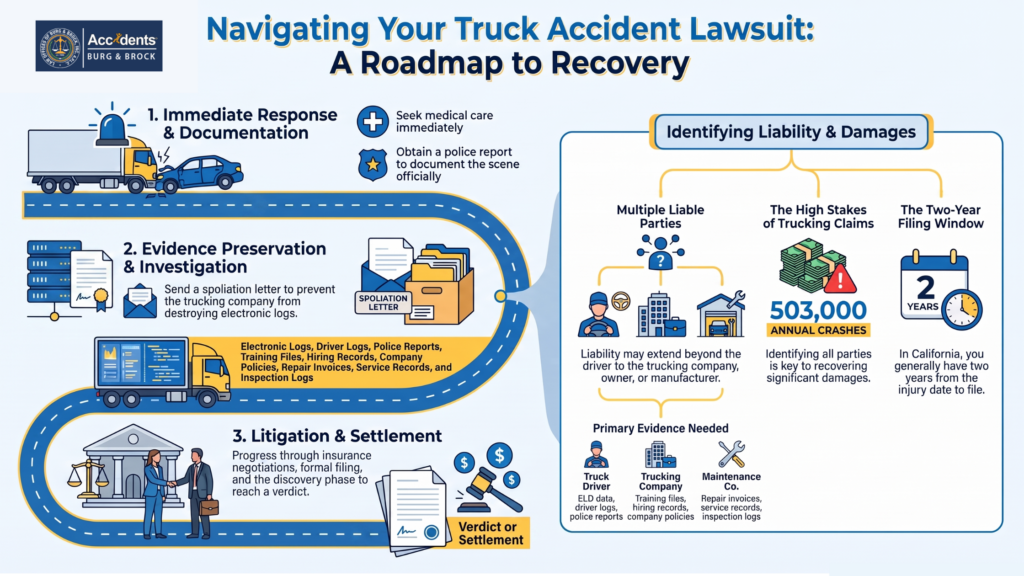
Absolutely. If a trucking company’s drivers or business practices played a part in your accident, you have the right to sue. According to the FMCSA, in 2022 alone, about 503,000 police-reported crashes involved large trucks, and about 114,000 of those resulted in injuries. If negligence caused your injuries, the trucking company or the driver (or both) may be held responsible.
Companies can also be liable for hiring unqualified drivers, poor training, inadequate supervision, or unsafe policies, even if the driver is an employee or, in some cases, an independent contractor. If you’ve suffered serious injuries, financial losses, or a death in the family due to their negligence, they may be liable.
Who Can Be Held Responsible After a Truck Accident?
After a commercial truck accident, there’s often more than one person or company who could be on the hook for damages. Cameron Yadidi, founder of Yadidi Law Group in California, always says, “Finding everyone who might be responsible can make all the difference when pursuing an injury claim.” The truck driver may be liable if reckless driving, such as speeding, driving while fatigued, or breaking the rules, caused the accident. These violations can increase crash risk, especially when drivers operate large commercial vehicles.
The trucking company may also share responsibility for a driver’s actions or its own mistakes. That can include hiring an unqualified driver, skimping on training, or failing to supervise drivers appropriately. If the company lets trucks fall into disrepair or pushes drivers to break safety rules, that’s on them too. Sometimes, an employer is held responsible for what its employees do, under a rule called vicarious liability.
It doesn’t stop there. The truck owner or maintenance crew could be responsible for mechanical failures caused by poor maintenance. If the cargo wasn’t loaded properly and contributed to the crash, the loader or shipper could be at fault. Manufacturers can get pulled in if a defective truck or part played a role. Sometimes, another motorist might even share the blame.
Potentially Responsible Parties In a Truck Accident
A truck accident can involve several potentially liable parties, depending on the facts of the crash. Identifying them can help you understand what compensation may be available. The table below shows common parties, their potential responsibility, and evidence that may support your claim.
| Potentially Liable Party | How They May Be Responsible | Evidence That May Support a Claim |
|---|---|---|
| Truck Driver | Speeding, truck driver negligence, distracted driving, fatigue, impaired driving, or safety violations | Driver logs, ELD data, phone records, police reports, witness statements |
| Trucking Company | Negligent hiring, not providing adequate training, supervision, maintenance, or unsafe practices | Driver records, training files, maintenance records, company policies |
| Truck Owner | Poor maintenance or defective equipment | Maintenance records, inspection reports, repair records |
| Maintenance Company | Improper or incomplete repairs that contribute to the crash | Repair invoices, inspection records, service records |
| Cargo Loader or Shipper | Improperly loaded or secured cargo contributes to the accident | Cargo records, loading documents, photographs, inspection reports |
| Truck or Parts Manufacturer | A defective truck or component contributes to the collision | Product records, maintenance history, expert inspections |
| Another Motorist | Negligent driving contributes to the crash | Dashcam footage, traffic footage, witness statements, police reports |
Having strong evidence is key. It helps show who played what role and strengthens your compensation claim. Since serious truck accidents often involve several parties and complicated or unclear evidence, a good attorney can help you find every possible source of liability.
How Do You Sue a Trucking Company?
To sue a trucking company, there are a few important steps you must follow. Knowing what to do ahead of time helps you protect your rights and avoid mistakes that could hurt your case. Here are the steps to take after a truck accident.
Step 1. Seek Medical Attention:
Get a medical checkup from a doctor immediately after your truck accident, even if you feel okay at first. Some injuries take time to show up and can worsen later. This also creates medical records that not only support your recovery but are also key to backing up your compensation claim.
Step 2. Report the Truck Accident:
Call the police and make sure they document everything about the accident. Their report will capture important details, including where the accident happened, which vehicles were involved, witness information, and the officer’s observations. Don’t forget to ask for a copy and hang onto it with your other records; it’s often a big help for your claim later.
Step 3. Preserve Evidence:
Save as much evidence as you can after the crash because trucking companies often control key records. Snap photos and videos of the scene, vehicle damage, road conditions, and any injuries. Gather witness names, contact information, and keep your medical records and police report. If there’s dashcam or surveillance footage, make sure to preserve that too.
Step 4. Send a Spoliation or Evidence Preservation Letter:
Because trucking companies often hold key evidence, an attorney can send a preservation letter to ensure that records and physical evidence such as electronic logs, vehicle data, maintenance files, and driver records are preserved. Acting fast helps prevent this information from being lost or changed while your claim is investigated.
Step 5. Identify Every Potentially Liable Party:
A truck accident lawsuit often involves more than just the driver and the trucking company. You must conduct a thorough investigation to identify everyone who may have played a part. This includes the driver, their employer, the truck owner, the maintenance crew, the manufacturer, or even the shipper. By identifying every possible liable party, you ensure that your claim covers all sources of negligence and every chance for compensation.
Step 6. Determine Your Damages:
Winning a trucking lawsuit isn’t just about showing who caused the crash; you also need to prove how it changed your life. That means documenting the impact on your health, finances, property, and everyday routine. Think medical bills, lost wages, vehicle damage, and pain and suffering. The more clearly you show these losses, the stronger your case for compensation.
Step 7. File an Insurance Claim and Negotiate:
Before jumping into a lawsuit, you’ll usually start by filing a claim with the trucking company’s insurer. Your attorney will draft a demand package along with medical records, proof of lost income, property damage, and more to back up your case.
The insurer might make a quick settlement offer, but don’t assume it covers everything. According to Cameron Yadidi, Founder and partner at Yadidi Law, “An early settlement offer may not account for the full extent of an injured person’s losses.” Make sure you know the true extent of your losses, both now and in the future, before agreeing to anything.
Step 8. File the Lawsuit:
If you can’t reach a fair settlement with the insurer, your next step is filing a lawsuit against everyone responsible. Your attorney will draft a complaint that lays out what happened, your injuries, who was negligent, and what compensation you’re seeking. Once it’s filed with the court, each defendant gets officially notified and has a chance to respond.
Step 9. Go Through Discovery:
Once your lawsuit is filed, both sides dive into discovery, a stage where everyone gathers evidence and builds their case. This means exchanging written questions, sharing documents, and taking depositions from the driver, company reps, or witnesses. Your attorney might bring in accident reconstruction or medical experts and request company records. Discovery often uncovers key evidence about driver behavior, company policies, maintenance, and what really led to the crash.
Step 10. Negotiate a Settlement or Go to Trial:
A trucking accident case may settle early, before a lawsuit is even filed, or later in the legal process. Your attorney will negotiate with the trucking company or insurer, possibly through mediation, to try for a fair deal. If there’s no agreement, the case heads to trial, where both sides present their evidence and arguments to a judge or jury.
How Long Do You Have to Sue a Trucking Company in California?
In California, you generally have two years to file a personal injury lawsuit after a truck accident. California Code of Civil Procedure Section 335.1 applies a two-year limit to injuries or deaths caused by another person’s wrongful act or negligence. Missing the applicable deadline can jeopardize your ability to recover compensation, so it’s important to determine your filing deadline as soon as possible.
Different deadlines may apply when a government entity is involved in the accident. California generally requires a claim for personal injury or property damage against a public entity within six months. Exceptions can also affect when the clock starts or how long you have to file, depending on the facts of your case. For that reason, speaking with an attorney early can help you identify the deadline that applies to your claim and protect your right to pursue compensation.
What Compensation Can You Recover From a Trucking Company?
You can recover economic damages for financial losses caused by the truck accident. This includes expenses such as emergency care, ongoing medical bills, lost wages, reduced earning power, and the cost to repair or replace your vehicle. If you’re partly at fault, under California’s comparative negligence rules, your compensation gets reduced by your share of the blame.
Non-economic damages cover things money can’t easily measure. They may include pain and suffering, emotional distress, loss of enjoyment of life, and more. Punitive damages are rare and usually only come into play if the other side acted with malice, oppression, or fraud.
If a truck accident results in a death, eligible family members can bring a wrongful death lawsuit. Compensation may include funeral costs, lost financial support, and loss of companionship, sometimes more, depending on the situation and family relationship.
What Are the Challenges You May Face When Suing a Trucking Company?
Trucking companies usually have deep pockets and a strong defense team when facing accident claims. Their insurers may bring in seasoned adjusters, defense attorneys, and investigators, all working to protect the company’s interests. As Isaac Radnia, a California attorney at Yadidi Law, puts it, “These companies have dedicated teams, and you deserve experienced counsel, too.”
Gathering crucial evidence becomes tough because the trucking company often controls key records, such as electronic log data, maintenance reports, driver files, and inspection documents. And some of this evidence may disappear with time, so acting quickly to preserve it is essential.
Truck accidents often involve multiple parties, and they may each deny responsibility for the crash. The driver, trucking company, truck owner, maintenance crew, manufacturer, shipper, or even another driver could be partly to blame. Finding every potentially responsible party is crucial in getting the full compensation you deserve. The trucking company may also question your account of the crash, extent of your injuries, or the value of your damages. Insurers sometimes push for a quick settlement before you truly know the impact of your losses.
Strict filing deadlines can affect your right to sue. In California, you generally have two years for personal injury claims, but some cases, like those involving government entities, may have even shorter deadlines. Knowing which deadline applies to you is critical, because missing it can jeopardize your case.
How Can a Personal Injury Lawyer Help?
A personal injury lawyer can investigate your truck accident to figure out who’s truly at fault. This includes gathering and preserving evidence, reviewing police reports, reviewing driver and company records, and ensuring you don’t overlook any at-fault party.
Your truck accident lawyer can also help you estimate your damages from medical bills, lost income, property repairs, and non-economic losses. They’ll handle communication with insurance companies and insurance adjusters, prepare the paperwork, and keep you on top of critical deadlines.
If your case goes to court, your lawyer will coordinate discovery and team up with experts, like accident reconstruction specialists and medical professionals, to build your case. They’ll communicate with the trucking company or insurer, ensuring that any settlement negotiation matches your real losses. If talks break down, your attorney will get your case trial-ready and present strong evidence on your behalf. With someone handling the legal heavy lifting, you can focus on healing while your case moves forward.
Hypothetical Case Example:
Imagine Maria. She was seriously hurt when a commercial truck slammed into her car, leaving her with painful back and leg injuries requiring ongoing care. She also missed months of work while medical bills continued piling up. When the trucking company’s insurer stepped in, it accepted some responsibility but offered a settlement that fell short of Maria’s losses. That’s when Maria turned to Yadidi Law for help.
The legal team gathered the police report, preserved evidence, reviewed the truck driver’s records, and investigated the trucking company’s practices. They uncovered signs of negligent hiring and found evidence suggesting a maintenance company could share responsibility. After negotiations failed to produce an offer that reflected Maria’s losses, the team explained her legal options, and Maria decided to file a lawsuit. Yadidi Law then presented evidence supporting her claim and pursued compensation for her injuries and losses.
This is a hypothetical example for illustration purposes only. Results vary depending on the facts and circumstances of each case.
Have You Been Involved in a Truck Accident?
If you’re suffering damages from a truck accident, you do not have to handle the process alone. A personal injury attorney can investigate the accident, preserve evidence, handle insurers, manage litigation, and negotiate for compensation. If a fair settlement cannot be reached, your attorney can prepare your case for trial. If you were injured or lost a loved one in a truck accident, consider contacting an experienced accident attorney to discuss your legal options.
An experienced personal injury attorney can investigate the crash, secure important evidence, handle the trucking company’s insurance company, and fight for the compensation you deserve. If a fair settlement isn’t possible, your truck accident attorney can also take your case to trial and represent you in the appropriate court.
At Yadidi Law Group, we have handled personal injury cases since 1996. Our California team handles truck accident cases across the state. If you’ve been hurt or lost someone you love in a truck accident, contact us for a free case evaluation and discuss your legal options.
Frequently Asked Questions
Taking legal action against a trucking company is often more complicated than a standard car accident claim. Questions about who’s responsible, what evidence is needed, and how deadlines work can quickly surface. We’ve answered some of the most common questions below, so you know what to expect and how to move forward.
Can I Sue a Trucking Company After a Car Accident?
Yes, you may be able to sue a trucking company if its negligence caused the accident resulting in your injuries or losses. To get compensation, you generally need to prove the company’s legal responsibility and the damages you suffered.
Can I Sue a Trucking Company if the Driver Was an Independent Contractor?
Yes, you might still have a claim against the trucking company even if the driver was an independent contractor. Whether the company is liable can depend on how much control it had over the driver, whether it acted negligently, and the unique details of your situation.
What Evidence Do I Need to Sue a Trucking Company?
Important evidence can include accident photos, witness statements, medical records, police reports, driver logs, ELD data, maintenance records, and truck data. These records can help establish who was responsible, how the accident happened, and the losses you suffered.
How Long Do I Have to Sue a Trucking Company in California?
In California, you generally have two years from the injury date to file a personal injury lawsuit. Exceptions and shorter deadlines may apply to claims against government agencies, so speak with an attorney early.
Can I Sue Both the Truck Driver and Trucking Company?
Yes, you may be able to sue both the truck driver and trucking company when both may share responsibility for the accident. The specific parties and claims depend on the facts and evidence of your case.
How Much Compensation Can I Get From a Trucking Company Lawsuit?
The compensation you get usually depends on your injuries, financial losses, fault, and other circumstances of the accident. You may recover damages for medical expenses, lost income, property damage, pain and suffering, and other qualifying losses.
Do I Need a Lawyer to Sue a Trucking Company?
You don’t have to hire a lawyer to sue a trucking company, but having legal help can make a big difference. Truck accident cases are often complicated, with multiple parties involved, lots of evidence to sort through, and big insurance companies on the other side. All these make it hard to handle by yourself. California Courts suggest talking to an attorney if your injuries are serious, your losses are significant, or there are several people or companies who might share responsibility.
How Long Does a Trucking Company Lawsuit Take?
A trucking company lawsuit can take several months to several years, depending on the case’s complexity. Factors such as disputed liability, evidence, negotiations, discovery, and trial can affect the timeline.
Disclaimer: Attorney Advertising. This blog provides general information about suing a trucking company and is not legal advice. Every truck accident case is different, and the information provided does not create an attorney-client relationship or guarantee a specific result. Laws and filing deadlines may change, and some exceptions may apply. For advice about your specific circumstances, contact an experienced personal injury attorney.


