
Either the driver, the trucking company, or both can be liable after a truck accident. The driver is liable when their own negligence caused the crash, such as speeding or driving while fatigued, and the company can be liable under respondeat superior or for its own negligence in hiring, training, or maintenance. Other parties can share fault too, including cargo loaders and maintenance providers, and sorting out who is responsible is what decides who pays for your damages.
At Yadidi Law Group, truck accident and personal injury work is not a sideline, it is the core of our practice. Cameron Yadidi has represented victims in commercial truck accident and catastrophic injury cases since founding the firm in 1996. If you were injured in a truck accident, contact us for a free legal consultation to discuss your legal options.
In this article, we will explain who can be liable after a truck accident, how liability is proven, and how state and federal regulations play a role in determining liability.
Who Can Be Liable After a Truck Accident?
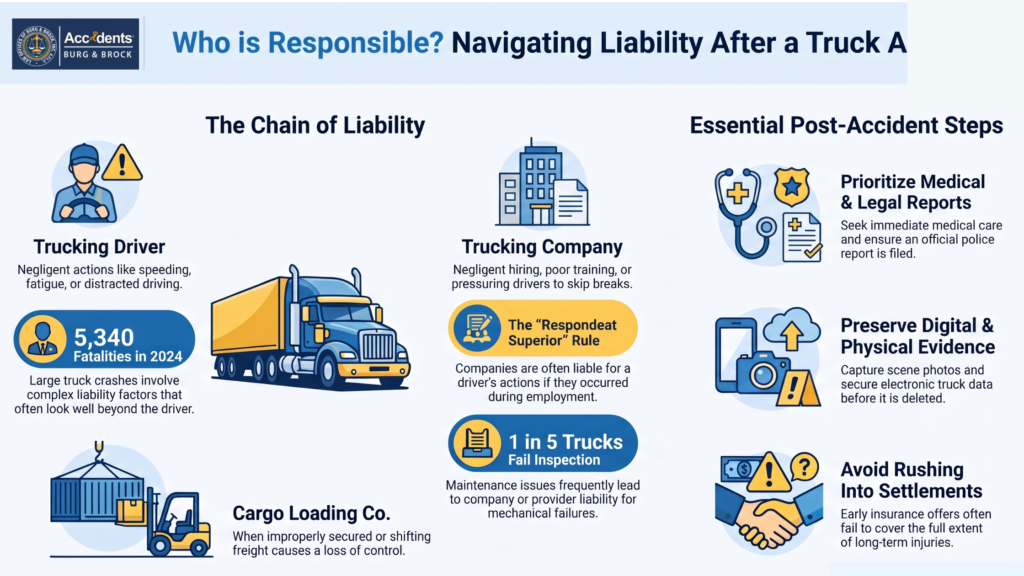
According to NHTSA, large trucks were involved in crashes that killed 5,340 people in 2024 alone, and working out who is actually responsible usually means looking well past the driver. Depending on how the crash happened, several parties can share responsibility. The commercial truck driver may be responsible if reckless or distracted driving caused the accident. The trucking company or motor carrier may also be liable in a truck crash, either through the driver’s actions or through its own negligence.
If the truck owner maintained the vehicle poorly, ignored known defects, or let unsafe equipment contribute to the accident, they may be liable. The cargo loading company can be on the hook as well, when freight that was not secured properly caused the crash.
Maintenance providers may also share fault if poor repairs led to a mechanical failure. And sometimes it is another driver on the road who sets the whole thing in motion, switching lanes or otherwise contributing to the crash. The table below breaks down the potentially liable parties in a truck accident.
| Potentially Liable Party | When They May Be Responsible | Example |
|---|---|---|
| Truck Driver | If their negligent actions caused or contributed to the crash | Speeding, distracted driving, fatigue, or DUI |
| Trucking Company | If the driver caused the crash while working, or the company was negligent | Negligent hiring, training, supervision, scheduling, or maintenance |
| Truck or Trailer Owner | Unsafe equipment or poor vehicle maintenance contributed to the accident | Ignoring known defects or failing to repair faulty brakes |
| Maintenance Provider | Improper repairs or maintenance caused a mechanical failure | Failure to properly repair a truck’s steering or braking system |
| Cargo Loading Company | If improperly loaded or unsecured cargo caused the crash | Shifting cargo causes the truck to lose control |
| Manufacturer | A defective truck or part contributed to the accident | A defective tire or braking component fails |
| Another Driver | Their actions contributed to the collision | Unsafe lane changes or cutting off the semi truck |
When Is the Truck Driver Liable for a Truck Accident?
A truck driver faces direct liability when their own negligent behavior contributed to the accident. That covers driving above the speed limit, traffic violations, texting while driving, and aggressive maneuvers. FMCSA researchers found that driver action or inaction was a critical factor in the vast majority of truck accidents, which puts driver conduct at the center of most liability questions.
Fatigue is one of the most common examples. Drivers sometimes ignore hours-of-service rules to meet tight deadlines, and exhaustion behind the wheel of an 80,000-pound truck can be just as dangerous as any other driving error. Driving under the influence is another clear path to liability, whether the substance is alcohol, drugs, or certain medications. Even small impairments can slow reaction time enough to cause serious harm.
Unsafe lane changes, following too closely, or other basic driving errors can also lead to liability as well. They might seem minor, but they account for a large share of truck crashes every year. Commercial trucks carry enough size and weight to turn a small mistake into serious harm, which is why drivers are held to strict federal standards. When a truck driver’s negligence contributed to a crash, the law holds them responsible for the resulting damage.
When Is the Trucking Company Liable for a Truck Accident?
In a truck accident, liability usually does not stop with the driver. It can extend to a trucking company for several reasons. The most common one is vicarious liability, built on a legal doctrine called respondeat superior. Under this rule, a company can be held responsible in a truck crash for a driver’s actions if the driver was acting within the scope of employment. It does not require the company to have done anything wrong itself, just that the driver was on the clock.
Companies can also face direct liability for their own decisions. They are expected to properly vet drivers before hiring, checking driving records and qualifications. Skipping that step and putting an unqualified driver behind the wheel can open the door to liability. The same applies to training and supervision, since companies must properly prepare drivers and monitor their performance over time. Failing to do so puts other drivers at risk, and if it leads to a crash, the company can be held ultimately responsible.
Inspecting and maintaining trucks is the company’s responsibility, not just the driver’s. Nearly one in five roadside truck inspections results in an out-of-service order, often tied to maintenance issues a company should have caught. If a failure like this leads to an accident, the maintenance company may be liable for skipping inspections.
A company pressuring drivers can create liability too, even without a hands-on mistake. This often shows up through unsafe scheduling or pushing drivers to violate hours-of-service rules. Federal law limits truck drivers to 11 consecutive hours behind the wheel, and pushing past that limit leads to fatigue. A fatigued driver on the road is a real danger, and if a company created that pressure, it can be just as responsible as the driver who eventually crashes.
Finally, federal and state trucking regulations exist to protect everyone on the road, not just the people inside the truck. Violating them, whether through weight limits, inspection requirements, or other safety regulations, can open the door to strict liability on its own.
Can Both the Driver and Trucking Company Be Liable?
Yes, the driver and the trucking company can be liable for the same accident, and it happens often in truck accident cases. A driver can be personally liable for their own negligence, like speeding or distraction. That liability can extend to the company as well, if the driver was working on company time. The company can also be liable for its own negligence, like poor hiring or poor supervision, separate from anything the driver did.
Here is how that might play out. Imagine a driver who has worked over 11 hours and is already fatigued. The company kept pressuring them to meet an unrealistic delivery deadline. Exhausted, the driver crashes. The driver could be liable for unsafe driving, since fatigue slows reaction time behind the wheel. The company could be liable too, for creating the unsafe conditions that led to it. One side failed to drive safely. The other failed to set safe conditions. Both failures fed the same outcome, so both parties may face consequences. Determining how much the at-fault parties contributed is often the real work in a truck accident case.
Does It Matter if the Driver Is an Employee or Independent Contractor?
Yes, it matters, but maybe not the way you would expect. After a crash, trucking companies sometimes argue the driver was an independent contractor rather than an employee, hoping to escape liability. It is a common argument, too.
The label on paper does not settle the question. Courts look at how much control the company actually had over the driver’s day-to-day work. Who set the schedule? Who assigned the routes? If the company controlled both, it starts to look a lot like an employment relationship, regardless of what the contract says.
A few other details are also considered. How the driver got paid matters, since a steady wage points toward employment, while per-load pay points toward contractor status. Truck ownership tells a similar story, because a driver leasing equipment from the company looks different than one who owns and maintains their own rig. Even permits and insurance play a role, especially whose name is actually on them.
None of these factors decide anything on their own. Together, they build a picture of the real working relationship, not just the one written into a contract. That is ultimately what courts care about, and it is why calling someone a contractor does not automatically get a company off the hook.
How Is Liability Proven After a Truck Accident?
Proving liability after a truck accident comes down to showing negligence, which has four key parts. First, every driver and company has a duty of care, a responsibility to keep roads safe for everyone. If that duty is ignored through speeding, fatigue, or skipped maintenance, that’s called a breach. Next, the breach must directly cause the crash, not just be something going on in the background. Finally, you must have actual damages, such as medical expenses, lost wages, or pain and suffering. For a negligence claim to stick, you must clearly prove all four parts.
Building a strong case takes solid evidence, and truck accidents usually leave quite a trail. Police reports and witness statements are the usual starting point, along with photos or videos from the scene. Digital evidence like electronic truck data, driver logs, and hours-of-service records can help show whether fatigue or risky driving was involved.
Maintenance reports and hiring or training files sometimes reveal whether a company cut corners before the accident. Cargo records and expert opinions can also help fill in the gaps. Trucking companies often control this evidence, so acting quickly to secure it can change the outcome of your case.
How Can State Laws Affect Truck Accident Liability?
Every state has its own rules that matter when determining truck accident liability. California follows a comparative fault system, meaning compensation can be reduced based on how much you contributed to the crash. Multiple parties can bear responsibility, so identifying the right defendants matters as much as proving fault. California generally gives injured people two years to file a personal injury lawsuit, though the exact deadline can shift depending on the claim’s details.
Other states handle these same issues differently. Comparative negligence rules vary, and some states cut off compensation entirely once fault crosses a certain threshold. Liability allocation among multiple parties isn’t universal either. Filing deadlines vary by state, and employer liability rules can differ too. Because of these differences, it is worth understanding the rules where the accident happened. That alone can shape how the entire case plays out.
What Should You Do After a Truck Accident?
It’s normal to feel overwhelmed and confused after a truck accident. These are some steps you can follow if you have been involved in one.
Step 1. Seek Medical Attention: Get checked out right away, even if you feel fine. Some injuries, like internal bleeding or concussions, do not show symptoms immediately.
Step 2. Report the Accident: Call the police and make sure an official report gets filed. That report often becomes key evidence later in your case.
Step 3. Preserve Available Evidence: Take photos of the scene, vehicle damage, and any visible injuries. Evidence can disappear fast, so document what you can before it is gone.
Step 4. Document your Injuries and Losses: Keep records of medical bills, lost wages, and anything else tied to the crash. This paper trail matters when it’s time to calculate damages.
Step 5. Avoid Rushing Into a Settlement: Insurance companies often offer quick settlements before the full extent of the victim’s injuries is clear. Accepting early can mean giving up compensation you are actually owed.
Step 6. Speak with a Truck Accident Attorney: Truck accidents often involve more than one liable party, and identifying them takes real investigation. An attorney can help pinpoint every defendant and pursue the compensation you deserve.
How Can a Truck Accident Lawyer Help You?
Truck accident cases are rarely straightforward, which is why having experienced help on your side makes all the difference. A good personal injury lawyer will investigate every detail to piece together the real story of what happened. Often, that kind of thorough investigation uncovers responsible parties you might never have suspected.
Acting quickly to preserve evidence matters just as much. Important records and digital data can vanish if no one secures them early. Trucking companies keep detailed files on everything from hiring to maintenance, and an attorney knows exactly how to get ahold of them before they disappear.
When things get complicated, an attorney can call on accident reconstruction industry experts who know how to break down what went wrong. They will also handle all those insurance negotiations on your behalf, and if needed, provide legal representation. And if more than one party shares the blame, your attorney can pursue compensation from everyone involved. This kind of detailed, persistent work often separates a fair result from walking away empty-handed.
Still Wondering Who’s Responsible for Your Truck Accident?
The driver is not always the only party responsible for a truck accident. The trucking company can share liability too, whether through the driver’s conduct or its own negligence in hiring, training, or maintenance. Sometimes several parties are responsible at once, from cargo loaders to maintenance providers to the company itself.
A thorough investigation is often what identifies everyone who should be held accountable. If you are still unsure who is liable for your accident, speaking with a truck accident attorney can help you get real answers and pursue the fair compensation you deserve.
At Yadidi Law Group, our team in California has represented injured people since 1996. We know how to identify every liable party and stand up to insurance companies. If you are trying to figure out who is responsible for your truck accident, reach out for a free consultation.
Frequently Asked Questions
Truck accidents often raise questions about liability. If you’re still confused, here are answers to some of the most common ones we hear.
Is the Truck Driver Always Liable for a Truck Accident?
No, the driver isn’t always the one at fault. Trucking companies, maintenance providers, cargo loaders, and other potentially liable parties can share responsibility or be solely responsible, depending on what caused the crash.
Can the Trucking Company Be Liable Even if the Driver Caused the Crash?
Yes. Under vicarious liability, a company can be held responsible for a driver’s actions if the driver was acting within the scope of employment.
Can Both the Truck Driver and Trucking Company Be Held Liable?
Yes, liability can extend to both. The driver may be liable for unsafe driving, while the company may be liable for its own negligence or for the driver’s conduct.
Is a Trucking Company Liable for an Independent Contractor?
It depends on the working relationship, not just the label used. Courts look at company control over scheduling, routes, and equipment to decide whether the driver was more like an employee.
How Do I Prove the Trucking Company Was Responsible?
To prove liability, you need evidence like maintenance records, hiring and training files, driver logs, and hours-of-service records to show negligence. An attorney can help gather and review this evidence, since trucking companies often control access to it.
How Long Do I Have to File a Truck Accident Lawsuit?
Filing deadlines vary by state, and in California, it is generally two years from the date of the accident. Since deadlines and exceptions differ, it is best to confirm your specific state’s timeline.
Disclaimer: This blog is for informational purposes only and does not constitute legal advice. Reading it does not create an attorney-client relationship with Yadidi Law Group. Past results, including any case outcomes referenced here, do not guarantee a similar outcome in your case, and hypothetical examples are for illustrative purposes only. This blog may be considered attorney advertising. Please consult a licensed attorney directly for advice on your specific situation.


